
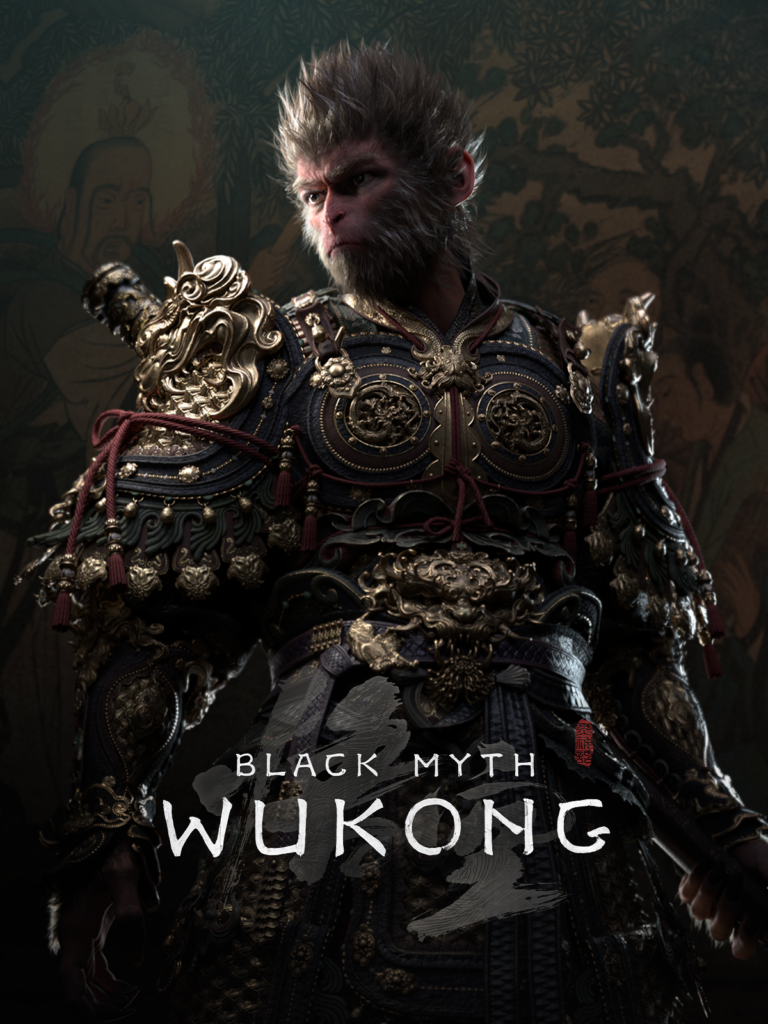
Recent adaptations: Black Myth Wukong
What is it?
Black Myth Wukong is a 2024 RPG game developed by Game Science, based on the Classic Chinese Novel Journey to the West. In this game, Players take on the role of the “Destine One,” an unnamed staff-wielding monkey who embarks on a journey to recover the six relics tied to the original Sun Wukong’s legendary senses.
This game is essentially a modern retelling of the Journey to the West and Sun Wukong’s Legend. Many of the characters and themes from the original Journey show up in the game. Zhu Bajie, who was Sun Wukong’s old and close companion, journeys with the Destined One, helping and protecting him. Erlang Shen, another character, also appears in the game and is one of the first we are introduced to. The game also plays the original theme song from the 1986 Journey to the West series, which really resonated with many Asian players.
Sun Wukong
Who is He?
Sun Wukong, also known as the Monkey King, is one of the most iconic figures in Chinese mythology and the central character of the classic 16th‑century novel Journey to the West. He embodies rebellion, transformation, and enlightenment, making him both a mischievous trickster and a profound spiritual symbol in China.
Born from a magical stone infused with the essence of Heaven and Earth, he quickly rose to become king of the monkeys. He later mastered Daoist arts that granted him immortality, shapeshifting, and superhuman strength, often using his powers for mischief and fun. After taking his legendary staff, JinguBang, from Ao Guang (King of Dragons) from the bottom of the sea, he rebelled against the Heavenly Court, defeating and humiliating countless Heavenly soldiers and gods. With his ego as big as the Empire State Building, he decided to call himself the Great Sage, Equal to Heaven, which angered the Court. Eventually, all that pride got to his head, and he was subdued by the Buddha and imprisoned under a mountain for 500 years. Only after he was freed by the monk Tang Sanzang did he join his master on a pilgrimage which would later be called the Journey to the West.
Sun Wukong predates the novel in terms of cultural origin. He first appeared in folk tales and oral traditions centuries before Wu Cheng’en’s text, with stories of a rebellious monkey spirit circulating as early as the Tang dynasty (7th–10th centuries). By the time Journey to the West was written in the 1500s, Sun Wukong had already been a legendary figure for hundreds of years, and the novel canonized him into the form we recognize today. In other words, Journey to the West is about 450 years old, but Sun Wukong as a mythic character is even older—likely over 1,000 years old in Chinese cultural memory.
While Wu Cheng’en, the author, likely did not create Wukong solely as a protest figure, Wukong’s defiance of Heaven has often been interpreted as a metaphor for the frustrations of ordinary people under the oppression of landlords, bureaucrats, and imperial power. In this way, he became a cultural symbol of rebellion and freedom, embodying the untamable human spirit that resists authority yet seeks enlightenment. Below is an animation that introduces the beginning of Sun Wukong’s legacy.
This is the 40th anniversary version of this movie. The animation has been made in higher quality, and most of the sound effects have been added as well. However, it’s also about half an hour shorter than the original, so I highly recommend watching the original; it’s just as easy to find on YouTube. The original, made in 1964, contains more traditional music, such as Peking Opera, than the remastered one above.
Journey to the West
After being freed by his master, Sun Wukong transforms from a reckless, arrogant trickster into a more disciplined protector and warrior on the Journey. He’s forced to wear the Golden Headband after Tang Sanzang realises he’s incredibly disobedient and uncontrollable. On the Journey, they meet the rest of the group, Zhu Bajie, a once Heavenly General turned into a gluttonous pig, and Sha WuJing, a quiet river ogre seeking redemption. Together, they travel to India to retrieve the sacred scriptures of enlightenment to bring back to their people.
Their journey stretches across thousands of miles, through mountains, rivers, deserts, and foreign lands. At every stage, they face monsters, demons, and spirits who crave Tang’s flesh, believing it will grant them immortality. Sun Wukong’s cunning and strength are often the group’s salvation, though Tang’s discipline must check his arrogance. Zhu BaJia’s laziness and greed cause trouble, while WuJing remains steady and loyal.
After 81 trials, they finally reach India, where Tang Sanzang receives the scriptures. Returning to China, each disciple is rewarded: Tang achieves Buddhahood, Sun Wukong is freed from his headband and honoured as a true protector, Zhu BaJie is given a heavenly post, and WuJing attains sainthood. The journey ends not just with the scriptures, but with the transformation of each character—turning rebels and sinners into enlightened beings.
This show was aired in 1986, and remains a nostalgic part of many lives, including mine and my parents. This was the show that Black Myth Wukong continued from, and watching through this playlist, you can notice that the game actually references so many characters and settings from the show, including the main theme song. The cool part is that, since CGI and greenscreens weren’t as developed back then, the mountains and valleys you see in the show are real. I highly recommend watching it; it’s an incredibly entertaining journey to be a part of.